
Best High-Fiber Foods to Add to Your Diet
Which Foods Actually Contain the Most Fiber?
Imagine it’s Saturday morning.
You walk into your local grocery store planning to eat a little healthier this week.
As you stroll through the produce section, colorful displays of apples, pears, berries, leafy greens, sweet potatoes, beans, oats, nuts, and seeds surround you. Nearly every health magazine, social media post, and nutrition article seems to recommend these foods.
But a simple question suddenly comes to mind.
If all of these foods are considered healthy… which ones actually contain the most fiber?
The answer isn’t as obvious as many people expect.
Some foods have earned a reputation for being “fiber-rich” simply because they’re popular in healthy eating conversations. Others quietly provide remarkable amounts of fiber without receiving nearly as much attention.
More importantly, focusing only on the number of grams of fiber can sometimes cause us to overlook something even more valuable: the overall nutritional package that whole foods provide.
The best high-fiber foods don’t simply deliver fiber.
They also provide vitamins, minerals, antioxidants, healthy fats, plant protein, and thousands of naturally occurring compounds that work together within the body in ways scientists continue to explore.
This is why nutrition experts consistently recommend building meals around a variety of minimally processed plant foods, rather than searching for one perfect ingredient.
By the end of this guide, you’ll not only know which foods naturally contain the most fiber—you’ll also understand why diversity matters far more than chasing a single “superfood.”
Why Fiber Is Found Only in Plant Foods
Before looking at specific foods, it’s worth understanding a fascinating fact:
Fiber exists only in foods that come from plants.
Meat contains no fiber.
Fish contains no fiber.
Eggs contain no fiber.
Milk contains no fiber.
This isn’t because these foods are unhealthy.
It’s because fiber is part of the physical structure that helps plants grow, protect themselves, retain water, and support seeds, stems, leaves, and fruit.
When humans eat plants, these natural structures become part of our diet.
Some fibers dissolve in water.
Others maintain their shape.
Some become food for beneficial gut bacteria.
Others help provide structure within the digestive tract.
Together, they create one of the most remarkable nutritional systems found in nature.
🌱 Quick Take
Fiber isn’t added to plants.
It is part of what makes a plant a plant.
Every bean, oat, apple, carrot, berry, and seed naturally contains fibers that evolved to help the plant survive long before humans understood nutrition.
So… Which Foods Naturally Contain the Most Fiber?
The surprising answer is…
Legumes often rank among the richest everyday sources of dietary fiber.
Many people immediately think of fruit when they hear the word “fiber.”
Fruit certainly contributes meaningful amounts.
But beans, lentils, chickpeas, split peas, and other legumes frequently provide considerably more fiber per serving while also supplying plant protein, iron, folate, magnesium, potassium, and numerous phytochemicals.
This helps explain why legumes have remained staple foods across many traditional dietary patterns for centuries.
According to the Harvard T.H. Chan School of Public Health, legumes are among the most nutrient-dense foods available and are regularly included in dietary patterns associated with long-term health.

Why Legumes Deserve More Attention
Imagine preparing a simple bowl of lentil soup on a cool evening.
At first glance, it feels like comfort food.
Nothing particularly extraordinary.
Yet inside that bowl is an impressive nutritional combination that nutrition scientists have studied for decades.
Lentils naturally provide dietary fiber, plant protein, iron, folate, magnesium, potassium, and numerous bioactive plant compounds—all packaged together in one minimally processed food.
This illustrates an important principle that appears repeatedly throughout nutrition science.
The healthiest foods rarely stand out because of a single nutrient.
They stand out because nature combines many beneficial components into one remarkably complete package.
That is one of the reasons whole foods continue to outperform nutrition trends centered around isolated ingredients.
Did You Know?
Some of the world’s longest-studied dietary patterns—including the Mediterranean diet and several traditional Blue Zone eating patterns—regularly include legumes as everyday foods rather than occasional side dishes.
Researchers believe this consistency may be just as important as the foods themselves.
Are Seeds Really That High in Fiber?
A tablespoon of seeds doesn’t look particularly impressive.
Scatter a few chia or flaxseeds over a bowl of oatmeal and they may seem almost insignificant compared with the fruit, oats, and yogurt underneath.
Nutritionally, however, seeds are remarkably concentrated foods.
Because seeds contain the biological materials needed to support the beginning of a new plant, they naturally package fiber alongside minerals, healthy fats, protein, and numerous plant compounds.
Chia seeds are an especially interesting example. When exposed to liquid, their outer layer absorbs water and develops a distinctive gel-like coating. If you’ve ever prepared chia pudding overnight, you’ve watched this transformation happen in your own refrigerator.
Flaxseeds provide another useful example. Along with dietary fiber, they naturally contain alpha-linolenic acid (ALA), a plant-based omega-3 fatty acid, as well as compounds known as lignans.
This doesn’t make seeds magical.
It simply makes them an unusually concentrated way to add nutritional variety to everyday meals.
And importantly, you don’t need enormous quantities.
A spoonful added consistently to foods you already enjoy can be much more practical than completely redesigning your diet.
How High-Fiber Foods Like Seeds Fit Into Everyday Meals
This is where nutrition advice often becomes unnecessarily complicated.
You don’t need a special “chia recipe.”
You can simply add seeds to foods already sitting on your breakfast table.
Sprinkle ground flaxseed over oatmeal.
Mix chia seeds into overnight oats.
Add seeds to yogurt with berries.
Blend them into a smoothie.
Use them in homemade whole-grain bread or muffins.
The goal isn’t to build your entire diet around one ingredient.
It’s to make fiber-rich foods easy enough to become ordinary.
That distinction matters.
A food that is nutritionally impressive but sits untouched in the pantry contributes nothing to your diet.
A simple ingredient you actually use every morning does.
What About Oats and Other Whole Grains?
If legumes are nutritional workhorses and seeds are concentrated packages, whole grains may be the quietest fiber sources of all.
They are ordinary.
Familiar.
Inexpensive in many places.
And remarkably easy to incorporate into everyday meals.
Oats, barley, bulgur, whole wheat, brown rice, quinoa, and other whole grains retain more of their original grain structure than highly refined alternatives.
A whole grain contains three major components: the bran, germ, and endosperm.
The bran is particularly important when discussing fiber because much of a grain’s dietary fiber is concentrated there.
During refining, portions of the bran and germ are removed. This changes not only the texture and shelf stability of the grain but also its nutritional composition.
That is why brown rice and white rice, or whole-wheat bread and refined white bread, can come from the same original plant yet provide different amounts of fiber.
The difference isn’t a mysterious ingredient.
It’s what remained after processing.
Why Oats Are Particularly Interesting
Oats deserve special attention because they contain a soluble fiber called beta-glucan.
When beta-glucan encounters water, it can form a viscous solution—another real-world example of the gel-forming behavior we explored in our guide to soluble and insoluble fiber.
But oats are valuable for a much simpler reason too:
They’re practical.
A bowl of oatmeal can become breakfast in minutes.
Overnight oats can be prepared the evening before.
Oats can be blended into smoothies, incorporated into homemade recipes, or combined with fruit, nuts, and seeds.
Sometimes the most useful nutritional foods aren’t the exotic ones.
They’re the ones you can realistically eat on a Tuesday morning when you’re already late for work.

Are Fruits Really One of the Best Sources of Fiber?
Fruit absolutely deserves a place in a fiber-rich diet.
But there’s an important distinction.
Fruit doesn’t necessarily win because it always contains the most fiber per serving.
It wins because it is incredibly easy to eat.
A pear requires no recipe.
An apple fits inside a bag.
Berries can be added directly to breakfast.
An orange comes with its own natural packaging.
That convenience matters enormously in real life.
Nutrition recommendations only become useful when people can actually follow them.
Why Eating the Whole Fruit Matters
Consider an orange and a glass of orange juice.
They may originate from the same fruit, but they aren’t nutritionally identical.
When you eat the whole orange, you consume the membranes, pulp, and structural plant material that contribute dietary fiber.
Juicing removes much of that structure.
This doesn’t mean fruit juice must never be consumed. It simply demonstrates something fascinating about nutrition:
The physical structure of food matters.
The same principle applies to many fruits.
Peels, skins, seeds, pulp, and cellular structures contribute to the nutritional characteristics of the whole food.
That’s one reason whole fruit generally plays a different role in healthy dietary patterns than fruit juice.
🍐 Quick Take
When choosing fruit for fiber, don’t obsess over finding the single “best” option.
Berries, pears, apples, oranges, kiwifruit, avocado, and many other fruits can contribute.
The fruit you enjoy enough to eat regularly is usually more useful than the “perfect” fruit you rarely buy.
Which Vegetables Provide the Most Fiber?
Vegetables create another interesting misconception.
Because vegetables are strongly associated with healthy eating, many people assume every vegetable must contain enormous amounts of fiber.
That’s not necessarily true.
Vegetables vary substantially in their fiber content.
Artichokes, green peas, Brussels sprouts, broccoli, sweet potatoes, carrots, and several other vegetables can make meaningful contributions, while some water-rich vegetables provide less fiber per serving.
But judging vegetables only by fiber content misses the point.
Vegetables provide an extraordinary range of micronutrients and phytochemicals, and their relatively low energy density makes them easy to incorporate throughout meals.
Broccoli doesn’t need to “beat” lentils.
They can share the same plate.
And that’s where dietary diversity becomes far more interesting than nutrient rankings.
The High-Fiber Foods Comparison Table
Numbers can be useful, provided we don’t turn them into a competition.
The values below are approximate because serving size, variety, preparation, and food databases can produce slightly different figures. They are intended to help visualize how dramatically fiber content can vary among everyday foods.
| Food | Typical Serving | Approx. Fiber | What Else It Brings to the Table |
|---|---|---|---|
| Cooked lentils | 1 cup | ~16 g | Plant protein, folate, iron |
| Cooked black beans | 1 cup | ~15 g | Plant protein, magnesium, potassium |
| Chia seeds | 1 oz (28 g) | ~10 g | ALA omega-3 fats, minerals |
| Raspberries | 1 cup | ~8 g | Vitamin C and polyphenols |
| Cooked green peas | 1 cup | ~9 g | Plant protein and micronutrients |
| Pear with skin | 1 medium | ~5–6 g | Vitamin C and plant compounds |
| Cooked broccoli | 1 cup | ~5 g | Vitamin C, vitamin K, phytochemicals |
| Cooked oatmeal | 1 cup | ~4 g | Beta-glucan and minerals |
| Apple with skin | 1 medium | ~4–5 g | Polyphenols and vitamin C |
| Almonds | 1 oz (28 g) | ~3–4 g | Healthy fats, vitamin E, magnesium |
These figures help reveal something that marketing rarely emphasizes:
Some of the best high-fiber foods are remarkably ordinary.
Beans.
Lentils.
Oats.
Fruit.
Vegetables.
Seeds.
Nuts.
No detox powder required.
No exotic berry imported from the other side of the world.
Just food.
For readers who want to understand why fiber behaves so differently from other carbohydrates, our foundational guide explores the entire journey: What Is Dietary Fiber? A Complete Beginner’s Guide
Did You Know?
A food doesn’t have to contain an extraordinary amount of fiber by itself to matter.
Imagine adding berries to breakfast, beans to lunch, an apple in the afternoon, vegetables at dinner, and a small portion of nuts or seeds somewhere in between.
None of those choices needs to carry the entire nutritional burden.
Their contributions accumulate.
This is one of the simplest—and most overlooked—principles of healthy eating.
What Does a High-Fiber Day Actually Look Like?
Nutrition tables are useful.
Real kitchens are better.
Imagine waking up on an ordinary Wednesday.
Breakfast is oatmeal topped with raspberries, chia seeds, and walnuts.
At lunch, you have a grain bowl with chickpeas, roasted vegetables, leafy greens, and a whole grain.
Later in the afternoon, you grab a pear.
Dinner includes lentils or beans alongside vegetables and another whole-food carbohydrate.
Nothing about that day looks like a “fiber diet.”
There is no special powder.
No elaborate protocol.
No meal that exists solely because it is healthy.
It’s simply a collection of ordinary foods arranged differently.
And that may be the most useful way to think about the best high-fiber foods:
Not as ingredients you need to chase.
But as foods you can gradually make more visible in your everyday life.

Is the Highest-Fiber Food Always the Best Choice?
No.
And this may be the most important section in the entire article.
Nutrition rankings are seductive because they simplify complicated questions.
We want the best fruit.
The healthiest vegetable.
The number-one grain.
The ultimate superfood.
But human nutrition doesn’t operate like a sports league.
A tablespoon of chia seeds may be remarkably fiber-dense, yet nobody should build an entire diet around chia.
Lentils may outperform many foods on a fiber-per-serving basis, but that doesn’t make berries unnecessary.
A pear doesn’t need to compete with broccoli.
Oats don’t need to defeat beans.
Each food contributes something different.
Once you understand that, the question changes from:
“Which food has the most fiber?”
to something far more useful:
“How many different fiber-rich foods can comfortably fit into the way I already eat?”
That is a question capable of changing a diet—not just winning a nutrition trivia contest.
How Can You Start Eating More Fiber Without Changing Your Entire Diet?
After seeing how many foods contain fiber, it’s tempting to open the pantry, replace everything at once, and declare tomorrow the beginning of a completely new diet.
That’s usually unnecessary.
A more practical approach is to look at meals you already enjoy and ask:
“Where could one more whole plant food fit?”
If breakfast is usually cereal, perhaps add berries or seeds.
If lunch includes rice, try adding beans or lentils.
If you need an afternoon snack, fruit and a handful of nuts may fit naturally.
If pasta is a regular dinner, experiment with a whole-grain version and add vegetables to the sauce.
These changes aren’t dramatic.
That’s precisely the point.
Nutrition habits become powerful through repetition, not novelty.
Why Increasing Fiber Gradually Can Be More Comfortable
There’s an important detail that sometimes gets lost in enthusiastic nutrition advice:
Going from a relatively low-fiber diet to a very high-fiber diet overnight may not feel particularly pleasant.
Fiber changes the physical environment of the digestive tract, and certain fibers are fermented by intestinal bacteria. A sudden large increase can therefore contribute to temporary bloating, gas, or digestive discomfort in some people.
A gradual approach gives your eating habits—and digestive system—time to adjust.
Hydration also matters because several forms of fiber interact with water as they move through digestion.
Rather than treating fiber as a challenge where “more is always better,” think about consistency and variety.
The goal isn’t to consume the largest possible amount tomorrow.
It’s to build an eating pattern you can comfortably maintain next month and next year.
🌱 Quick Take
Don’t turn fiber into another nutrition competition.
If your current diet contains relatively few fiber-rich foods, introduce additional fruits, vegetables, legumes, whole grains, nuts, and seeds gradually while maintaining adequate fluid intake.
Small changes still count.
What Are the Most Common Mistakes When Choosing High-Fiber Foods?
Knowing which foods contain fiber is only half the story.
How we choose and use those foods matters too.
Mistake #1: Assuming “Whole Grain” Automatically Means High Fiber
Packaging can be confusing.
A product may contain whole grains without necessarily providing a particularly large amount of fiber per serving.
Rather than relying exclusively on marketing language on the front of the package, check the Nutrition Facts panel and ingredient list when comparing packaged foods.
Mistake #2: Believing a Fiber Supplement Replaces Plant Foods
Fiber supplements can have legitimate uses, and some people may use them based on individual needs or professional guidance.
But a scoop of isolated fiber isn’t nutritionally identical to a bowl containing lentils, vegetables, whole grains, seeds, and herbs.
Whole foods bring along protein, vitamins, minerals, fats, polyphenols, carotenoids, and many other compounds.
Fiber is part of that package.
It isn’t the entire package.
Mistake #3: Looking Only at Fiber Numbers
Suppose Food A contains slightly more fiber than Food B.
Does that automatically make Food A healthier?
Not necessarily.
Nutrition involves the entire food, the rest of the diet, portion size, preparation, personal needs, and countless other variables.
Fiber content is useful information.
It isn’t a universal health score.
Mistake #4: Forgetting About Foods You Actually Enjoy
This may be the most overlooked mistake of all.
You could design the most nutritionally impressive menu imaginable, but if you dislike the food, the plan probably won’t last.
Perhaps you don’t enjoy lentils.
That’s fine.
Try beans.
Don’t like chia pudding?
Use oats.
Not interested in pears?
Try berries, apples, oranges, or other fruits.
Healthy eating has room for preference.
A sustainable diet should fit into your life—not require your life to revolve around it.
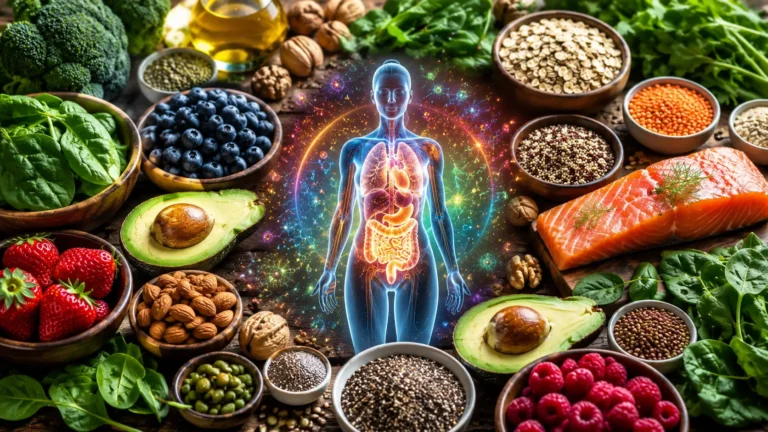
What Does Fiber Diversity Look Like on a Real Plate?
Let’s move away from nutrient charts for a moment.
Picture a dinner table.
There is a large bowl of lentils seasoned with herbs.
Roasted sweet potatoes.
Broccoli with olive oil.
A colorful salad.
A loaf of whole-grain bread.
Fresh fruit waiting for dessert.
Each ingredient contributes something different.
Some provide more soluble fiber.
Others provide more insoluble fiber.
Some contain fermentable fibers.
Others contribute resistant plant structures.
Alongside them come minerals, vitamins, plant protein, healthy fats, and phytochemicals.
No single ingredient needs to be perfect.
The diversity of the meal does the work.
And that is perhaps the simplest visual representation of what a fiber-rich diet actually looks like.

Frequently Asked Questions About High-Fiber Foods
What food is highest in fiber?
There isn’t one universally “best” high-fiber food because serving sizes and preparation methods differ. Legumes such as lentils and beans, as well as certain seeds, berries, whole grains, fruits, and vegetables, can all provide meaningful amounts of dietary fiber.
For everyday nutrition, variety is generally more useful than trying to identify a single winner.
Which fruits are high in fiber?
Raspberries, blackberries, pears, apples, oranges, avocado, and several other fruits can contribute meaningful amounts of fiber.
Whenever appropriate, eating the edible skin and pulp can help retain more of the fruit’s natural fiber.
Which vegetables are high in fiber?
Artichokes, green peas, Brussels sprouts, broccoli, carrots, sweet potatoes, and many other vegetables contribute dietary fiber.
Vegetables also provide numerous micronutrients and phytochemicals, so their value shouldn’t be judged by fiber content alone.
Are beans high in fiber?
Yes. Beans and other legumes are among the most concentrated everyday sources of dietary fiber.
They also naturally provide plant protein and nutrients such as folate, iron, magnesium, and potassium.
Are nuts and seeds good sources of fiber?
They can be.
Chia seeds, flaxseeds, almonds, pistachios, and several other nuts and seeds contribute fiber while also supplying healthy fats, protein, minerals, and plant compounds.
Because nuts and seeds are nutrient-dense, they don’t need to be consumed in enormous quantities to contribute to a varied diet.
Is oatmeal a high-fiber food?
Oats provide dietary fiber, including the soluble fiber beta-glucan.
What makes oatmeal particularly useful is its versatility. It can easily be combined with other fiber-rich foods such as berries, pears, chia seeds, flaxseeds, and nuts.
A simple bowl can therefore become a combination of several different plant foods.
Is it better to get fiber from food or supplements?
Whole foods offer an important advantage: fiber arrives alongside many other nutrients and naturally occurring plant compounds.
Fiber supplements may be useful for some individuals or circumstances, but they don’t reproduce the complete nutritional composition of fruits, vegetables, legumes, whole grains, nuts, and seeds.
Individual needs can differ, so questions about supplementation are best discussed with a qualified healthcare professional.
Conclusion: The Best High-Fiber Foods May Already Be in Your Kitchen
After exploring legumes, seeds, whole grains, fruit, vegetables, and nuts, you might expect the conclusion to reveal one extraordinary food that deserves the number-one position.
There isn’t one.
And that’s actually good news.
You don’t need an exotic superfood.
You don’t need an expensive powder.
You don’t need to redesign every meal.
Some of the best high-fiber foods are among the simplest foods humans have eaten for generations:
Beans.
Lentils.
Oats.
Whole grains.
Berries.
Apples.
Pears.
Vegetables.
Nuts.
Seeds.
What matters most isn’t finding the perfect one.
It’s allowing more of them to appear naturally throughout your week.
Perhaps oatmeal becomes breakfast twice a week.
Beans become part of lunch.
A pear goes into your work bag.
Vegetables take up a little more space at dinner.
Seeds find their way onto your morning oats.
None of those decisions seems revolutionary.
But healthy dietary patterns aren’t usually built through revolutionary meals.
They’re built through ordinary choices repeated often enough to become ordinary habits.
And maybe that’s the most useful way to think about fiber:
You don’t need to chase it.
Fill your meals with a diverse range of whole plant foods, and fiber tends to come along for the journey
Which fiber-rich foods already appear regularly in your meals?
Are you a lentil-and-beans person, an oatmeal fan, or someone who gets most of their fiber from fruits and vegetables?
Share your favorite foods—or your favorite way to prepare them—in the comments below. Your idea might inspire another VittaHealthy reader’s next meal.