
Soluble vs. Insoluble Fiber: What’s the Difference?
Walk into almost any grocery store and you’ll find products proudly advertising that they’re “high in fiber.” Turn the package around, however, and you’ll rarely discover what kind of fiber it actually contains.
This often leads to understandable confusion.
Some articles recommend soluble fiber.
Others praise insoluble fiber.
Some suggest taking supplements, while others insist whole foods are enough.
So which type is actually better?
The answer may surprise you.
The question itself assumes that these two forms of fiber compete with one another. In reality, they behave more like teammates than rivals. Each has unique physical characteristics, follows a slightly different journey through the digestive tract, and contributes to normal digestive physiology in its own way.
Understanding these differences doesn’t mean you need to memorize nutrition charts or count grams of specific fibers. Instead, it helps explain why nutrition experts consistently encourage eating a wide variety of plant foods rather than focusing on individual nutrients.
By the end of this guide, you’ll understand not only how soluble and insoluble fiber differ, but also why your body benefits from both.
Why Do We Even Have Different Types of Fiber?
At first glance, the idea seems strange.
If fiber is simply a carbohydrate that humans can’t fully digest, why would plants contain different kinds of it?
The answer begins with understanding that plants weren’t designed to nourish humans.
Fiber originally evolved because plants need structure, flexibility, protection, and water regulation to survive.
Some fibers strengthen stems and leaves.
Others help retain moisture.
Some form protective outer layers.
Others support the internal architecture of seeds and fruits.
When humans eat plant foods, these natural structures become part of our diet.
Instead of breaking them apart completely, our digestive system interacts with them in different ways depending on their physical properties.
This explains why scientists classify dietary fiber according to how it behaves, rather than where it comes from.
Not All Fiber Behaves the Same Way
Imagine placing two different materials into a glass of water.
One slowly dissolves into a thick, smooth gel.
The other remains almost unchanged, keeping its original shape.
Both are technically fibers.
Yet their behavior is completely different.
A similar process happens inside the digestive tract.
Some fibers readily absorb water and become soft, viscous, and gel-like as food moves through digestion.
Others resist this transformation, maintaining their structure throughout much of their journey.
Neither behavior is better.
Each simply creates a different physical environment inside the digestive system.
Understanding this simple distinction makes almost every other concept about fiber easier to understand.
Water Changes Everything
Water is one of the main reasons soluble and insoluble fibers behave so differently.
Think about preparing breakfast.
Pour hot water over rolled oats and wait a few minutes.
The mixture gradually becomes creamy and thick.
Now place chopped celery or wheat bran into the same bowl.
Those ingredients largely maintain their structure.
Exactly the same principle applies inside your digestive system.
The presence of water influences how different fibers interact with food, digestive enzymes, intestinal contents, and even the microorganisms living in your colon.
This is why nutrition researchers often describe fiber not simply as a nutrient, but as something that changes the physical environment of digestion itself.
According to the Harvard T.H. Chan School of Public Health, consuming a variety of fiber-rich plant foods naturally provides different forms of dietary fiber that contribute to healthy dietary patterns.

Soluble Fiber: The Fiber That Changes as It Travels
If insoluble fiber is like a sturdy wooden framework, soluble fiber behaves more like a sponge.
As it encounters water during digestion, it gradually absorbs liquid and forms a soft, gel-like consistency.
This physical transformation is the defining characteristic of soluble fiber.
Importantly, the gel itself is not the goal.
Rather, this change influences the environment through which food moves, creating conditions that scientists continue to investigate in relation to normal digestive physiology.
Many foods naturally rich in soluble fiber—including oats, beans, lentils, apples, pears, citrus fruits, barley, and flaxseeds—have long been staples of healthy dietary patterns around the world.
Interestingly, these foods also tend to contain a wide variety of vitamins, minerals, antioxidants, and phytochemicals.
Once again, fiber reminds us that nutrition is rarely about a single nutrient acting in isolation.
Instead, it is about the remarkable complexity of whole foods.
Did You Know?
Scientists have identified dozens of different fiber compounds naturally present in plants.
Although they are commonly grouped as “soluble” or “insoluble,” fiber is actually far more diverse than this simple classification suggests. Modern nutrition research continues to discover new ways these naturally occurring compounds interact with the digestive system and the gut microbiome.
How Your Gut Microbiome Uses Soluble Fiber
One of the most exciting discoveries in nutrition science over the past two decades is that you are never eating for yourself alone.
Every meal also feeds the trillions of microorganisms living inside your digestive tract.
Imagine a thriving city.
Some residents build roads.
Others collect waste.
Some generate energy.
Others help maintain essential infrastructure.
Now imagine what would happen if that city suddenly stopped receiving the resources it needed.
The same principle applies to your gut microbiome.
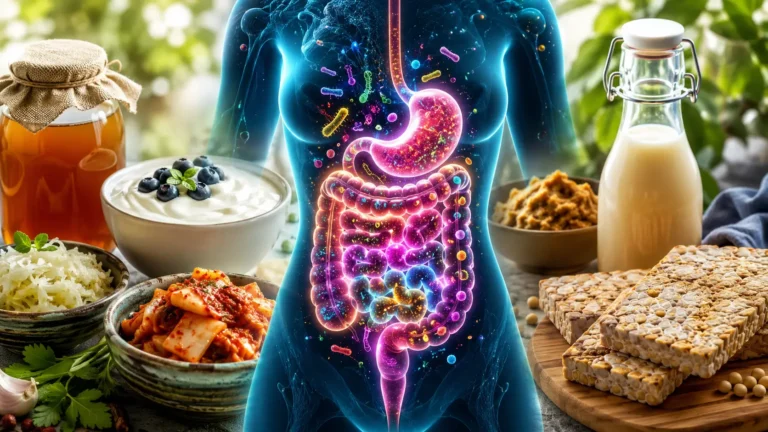
Many beneficial microorganisms depend on certain forms of soluble fiber because humans cannot fully digest them first. Instead, these fibers travel to the large intestine, where they become a food source for specific bacteria.
Through a process known as fermentation, these microorganisms transform portions of soluble fiber into compounds called short-chain fatty acids (SCFAs).
Researchers continue investigating these compounds because they appear to help nourish the cells lining the colon while participating in the complex communication network between the digestive system, the immune system, and normal human physiology.
This is one reason why nutrition scientists increasingly view fiber as something much more sophisticated than a nutrient associated only with digestive regularity.
Rather than simply “passing through,” soluble fiber becomes part of a remarkable biological partnership between humans and their gut microbiome.
Soluble Fiber Is Found in More Foods Than Most People Realize
Ask someone to name a food rich in soluble fiber, and the first answer is often oatmeal.
Oats are certainly an excellent example, but they represent only a small part of a much larger picture.
Many everyday foods naturally provide meaningful amounts of soluble fiber, including:
- Oats
- Barley
- Lentils
- Chickpeas
- Black beans
- Apples
- Pears
- Citrus fruits
- Carrots
- Sweet potatoes
- Flaxseeds
- Chia seeds
Notice something interesting.
These foods appear repeatedly throughout evidence-based dietary patterns such as the Mediterranean diet and other plant-forward eating styles studied around the world.
This is unlikely to be a coincidence.
Instead of relying on isolated nutrients, healthy dietary patterns naturally combine many different fiber sources within ordinary meals.
For readers interested in learning more about fiber itself, you may also enjoy: What Is Dietary Fiber? A Complete Beginner’s Guide
Insoluble Fiber: Nature’s Structural Engineer
If soluble fiber behaves like a sponge…
Insoluble fiber behaves more like the framework of a building.
It resists dissolving in water and largely maintains its physical structure as it moves through the digestive tract.
This characteristic gives insoluble fiber an entirely different role.
Imagine constructing a tunnel.
Without strong supporting beams, the tunnel could collapse under pressure.
In a similar way, insoluble fiber contributes structure and volume within the digestive tract.
Rather than changing into a gel, it retains much of its original form, influencing the physical movement of digestive contents through the intestines.
Scientists emphasize that this is a normal aspect of digestive physiology and one reason diets rich in vegetables, whole grains, legumes, nuts, and seeds have long been encouraged as part of healthy eating patterns.
Like soluble fiber, insoluble fiber does not work in isolation.
It arrives packaged inside foods that also provide vitamins, minerals, antioxidants, and thousands of naturally occurring plant compounds.
Foods Naturally Rich in Insoluble Fiber
Many people consume insoluble fiber every day without realizing it.
Excellent sources include:
- Whole wheat
- Brown rice
- Wheat bran
- Broccoli
- Cauliflower
- Green beans
- Cabbage
- Leafy greens
- Nuts
- Seeds
- Potato skins
- Apple skins
Interestingly, removing peels from fruits and vegetables often reduces part of their insoluble fiber content.
This doesn’t mean peeled produce is unhealthy.
It simply illustrates how different parts of plants naturally contain different structural fibers.
According to the Academy of Nutrition and Dietetics, choosing a variety of fruits, vegetables, legumes, and whole grains helps provide multiple forms of dietary fiber as part of a balanced eating pattern.

Do Foods Really Contain Only One Type of Fiber?
One of the biggest misconceptions about dietary fiber is the idea that foods fit neatly into one category.
In reality, nature rarely works that way.
Take an apple, for example.
It contains soluble fiber.
It also contains insoluble fiber.
The same is true for oats, beans, vegetables, berries, and many other plant foods.
Some simply contain higher proportions of one type than the other.
This is an important reason why nutrition experts rarely recommend trying to build a diet around only soluble or only insoluble fiber.
Whole foods naturally provide mixtures of fibers that have evolved together within plants over millions of years.
Perhaps the real lesson isn’t choosing the “right” type of fiber.
Perhaps it’s trusting the remarkable complexity already built into nature.
Did You Know?
Scientists have identified hundreds of different plant compounds that naturally accompany dietary fiber in fruits, vegetables, legumes, whole grains, nuts, and seeds.
Many researchers believe these compounds interact in ways that cannot be fully replicated by isolated nutrients alone, reinforcing the importance of eating a wide variety of whole plant foods.
Why Variety Always Beats Perfection
After learning about soluble and insoluble fiber, it’s easy to fall into a common trap:
“Should I focus on eating more soluble fiber?”
Or perhaps:
“Am I getting enough insoluble fiber?”
These questions are understandable, but they miss one of the biggest lessons in modern nutrition.
Nature rarely packages nutrients in isolation.
Imagine walking into an orchestra rehearsal.
One musician plays the violin.
Another performs on the cello.
Others play the flute, piano, or percussion.
No single instrument creates the entire symphony.
Healthier eating patterns work much the same way.
Beans contribute one combination of fibers.
Whole grains contribute another.
Vegetables offer their own unique mix.
Fruit provides yet another.
Rather than trying to build meals around a single type of fiber, nutrition experts generally encourage dietary diversity. The wider the variety of plant foods on your plate over time, the greater the diversity of fibers—and naturally occurring plant compounds—you expose your digestive system to.
This principle appears consistently across many of the world’s healthiest dietary patterns.
Why Colorful Plates Usually Mean Better Fiber Diversity
One simple habit can dramatically improve dietary variety without requiring complicated meal plans:
Eat more colors.
Different plants contain different fibers because they perform different biological functions.
Leafy greens need flexible structural fibers to support delicate leaves.
Beans store energy differently from grains.
Berries develop protective skins.
Root vegetables grow underground with completely different structural requirements.
When you eat a colorful variety of plant foods, you naturally consume a broader spectrum of dietary fibers.
Without counting grams.
Without memorizing nutrition tables.
Without worrying about perfection.
This is one reason why many nutrition professionals encourage people to think less about individual nutrients and more about building colorful, minimally processed meals.

Can You Get Enough Soluble and Insoluble Fiber Naturally?
For many healthy adults, the answer is yes.
A dietary pattern centered on vegetables, fruits, legumes, whole grains, nuts, and seeds naturally provides both soluble and insoluble fiber without requiring complicated calculations.
In fact, many everyday meals already combine several fiber sources.
Consider a simple lunch:
- Lentil soup
- Mixed green salad
- Whole-grain bread
- An apple for dessert
That single meal provides multiple types of dietary fiber together with vitamins, minerals, healthy fats, antioxidants, and countless phytochemicals.
This illustrates one of the central messages of evidence-based nutrition:
Healthy eating is rarely about chasing individual nutrients.
It is about creating consistent dietary patterns built around real foods.
Practical Tips for Eating More Fiber Without Overthinking It
Improving fiber intake doesn’t have to involve complicated meal plans or expensive specialty products.
Small, consistent habits often make the biggest difference over time.
Some simple ideas include:
- Replace refined grains with whole-grain alternatives when possible.
- Add beans or lentils to soups, salads, or rice dishes.
- Include fresh fruit with breakfast instead of sugary pastries.
- Snack on nuts or seeds alongside fruit.
- Keep frozen vegetables available for quick meals.
- Aim to include at least one plant food at every meal.
Rather than trying to dramatically increase fiber overnight, gradual improvements tend to be easier to maintain and more enjoyable in the long run.

Frequently Asked Questions
Is soluble fiber better than insoluble fiber?
No. Both types of fiber contribute to healthy dietary patterns and support normal digestive physiology in different ways. Most nutritious plant foods naturally contain a combination of both.
Which foods contain both soluble and insoluble fiber?
Many common foods—including apples, oats, beans, berries, vegetables, and whole grains—contain varying proportions of both types of dietary fiber.
Should I take a fiber supplement?
Some individuals may benefit from supplements under the guidance of a healthcare professional. However, for many healthy adults, obtaining fiber from a varied diet of whole plant foods remains the preferred approach because these foods provide many additional nutrients beyond fiber alone.
Does cooking remove fiber?
Most cooking methods do not eliminate dietary fiber. While texture and water content may change, cooked vegetables, legumes, and whole grains continue to provide meaningful amounts of fiber.
Conclusion
When comparing soluble vs. insoluble fiber, the most important takeaway is not deciding which one is “better.”
It is understanding that they were never meant to compete.
Each type of fiber contributes something unique to the remarkable journey food takes through the digestive system. Together, they help create an environment where digestion, the gut microbiome, and countless normal physiological processes can function as intended.
Fortunately, obtaining both forms of fiber does not require complicated nutrition plans.
Nature has already solved that problem.
By regularly enjoying a diverse selection of vegetables, fruits, legumes, whole grains, nuts, and seeds, you naturally consume an extraordinary variety of fibers exactly as they occur in whole foods.
Perhaps that’s the simplest lesson this comparison can teach:
The healthiest diets are built not by choosing one nutrient over another—but by embracing the remarkable diversity of plants that nature provides
Before reading this guide, did you think soluble and insoluble fiber competed with one another?
Has anything changed the way you think about fiber-rich foods?
Share your thoughts, favorite high-fiber meals, or questions in the comments below. We’d love to hear from you.